

Skills Insight: Engineering and manufacturing unpacked – National Manufacturing Day 2026
Date
23/09/2026
Category
Insights , News
As we approach National Manufacturing Day on 24 September, we took a deep dive into the data around the engineering and manufacturing sector, to see how the labour market is shifting and whether new technological trends are affecting the most-wanted skills lists.
We compiled data from Lightcast on vacancy levels, advertised skills, and employer expectations, to find out if the workforce can keep up.
Demand softening across the sector
From the peak of 2023, vacancy demand in the UK engineering and manufacturing sector has cooled considerably. Postings for each of the five highest-volume occupations within the sector remain below full-year 2025 totals – though they aren’t directly comparable, there are nonetheless some indications of demand driven down.
| Occupation | Total postings 2021–2025 | Full year 2025 | Jan-Aug 2026 | 2026 YTD vs 2025 full year |
| Mechanical engineer | 823,401 | 110,169 | 76,710 | -30% |
| Engineering technician | 773,439 | 109,780 | 64,869 | -41% |
| Production and process engineers | 674,259 | 84,374 | 55,856 | -34% |
| Assemblers and routine operatives | 458,283 | 57,019 | 46,124 | -19% |
| Electrical engineers | 444,766 | 66,035 | 44,959 | -32% |
Demand is softer across the whole sector, not in a single occupation. Four of these five occupations are critical to the government’s Industrial Strategy (not assemblers and routine operatives). These drops are more due to current market conditions rather than any reduction in importance.
Local economies shape the skills employers need
Regional skill demand continues to reflect local industrial strengths. Machinery is still the leading specialised skill in England, Northern Ireland, and Wales, where there is a broader manufacturing base.
There is a more diverse set of specialist skills in demand in Scotland. The drive for clean energy, and established strengths in the oil and gas sector are driving the nation’s demand for electrical engineering.
Scotland’s call for electrical engineering experts is strongest in the Highlands and Islands, Lothian, and Glasgow. In England in 2025, machinery was the most called-for skill in seven English regions, and has since replaced mechanical engineering in the South East. But this year, electrical engineering has become London’s leading specialised skill.
Spotlight on skills
We examined the market for a variety of different skills within the engineering and manufacturing sector, and found some interesting headlines.
AI skills still relatively niche
Demand for AI skills is increasing, but on the whole it’s still a relatively niche request within job ads. We looked at the number of unique postings for jobs in engineering and manufacturing between 2020 and 2026 to plot the demand for AI and other relevant skills.
The below table illustrates the number of unique posts per skill, and its percentage of all ads for roles within the sector posted that year.
| 2020 | 2021 | 2022 | 2023 | 2024 | 2025 | 2026 | |
| Total sector job ads posted | 465,287 | 985,335 | 858,497 | 867,431 | 606,667 | 581,047 | 413,500 |
| AI | 4,023 | 5,253 | 7,241 | 7,377 | 5,819 | 7,527 | 8,354 |
| Robotics | 4,844 | 6,108 | 7,188 | 7,119 | 5,243 | 5,553 | 5,098 |
| Automation Engineering | 33,040 | 40,874 | 54,733 | 60,599 | 45,149 | 47,976 | 37,969 |
| AI | 0.86% | 0.53% | 0.84% | 0.85% | 0.96% | 1.30% | 2.02% |
| Robotics | 1.04% | 0.62% | 0.84% | 0.82% | 0.86% | 0.96% | 1.23% |
| Automation Engineering | 7.10% | 4.15% | 6.38% | 6.99% | 7.44% | 8.26% | 9.18% |
- AI skills have more than doubled in demand in the last six years, going from 4,023 unique posts in 2020 to 8,354 in 2026.
- The share of all job ads in which AI is mentioned as a requested skill grew from 0.96% in 2024, to 1.3% in 2025, and jumped past 2% to 2.02% in 2026.
- Over the last six years, the number of posts mentioning AI has caught up to and overtaken the number of posts mentioning robotics. In 2022 there were just 53 more posts for AI – in 2026 that figure grew to 3,256.
Despite this impressive growth, AI skills are still mentioned in only 1 out of every 50 engineering and manufacturing job vacancies – automation engineering skills are at almost one in ten.
New technical skills are breaking through
The five most requested specialised skills in 2026 are each requested less than their 2021-25 averages. A further shake-up has seen two skills replaced in the top five for 2026: engineering drawings (2.2%) and tooling (2.1%) are new at number four and five.
| 2021-25 | 2026 | |
| Machinery | 5.26% | 5.19% |
| Mechanical engineering | 4.27% | 3.53% |
| Electrical engineering | 3.93% | 3.52% |
| New product development | 1.71% | n/a |
| AutoCAD | 1.64% | n/a |
Common skills are on the rise
Against the backdrop of rising demand for AI skills, there is also an increase in demand for people skills. Of the top five most-requested common skills in job adverts, the figures for four are higher than the 2021-2025 average.
Most requested common skills in sector job adverts, 2021-25 vs 2026:
| 2021-25 | 2026 | |
| Problem solving | 10.65% | 11.95% |
| Detail oriented | 8.35% | 10.99% |
| Planning | 6.52% | 5.57% |
| Leadership | 5.65% | 7.26% |
| Troubleshooting | 4.80% | 5.24% |
Leadership overtakes planning as the third most requested common skill in 2026 job ads, but these increases show that employers are still very much focused on what their human hires can bring to the table.
The fastest-rising skills in 2026 are:
- reliability, up by 0.98 percentage points on last year
- coordinating, which was up four-fifths of a point (0.81).
Entry route and salary data
The data for job vacancy adverts posted between 2021 and 2025 shows that employers make the most requests for candidates with A Levels, and an average three years across the occupations covered.
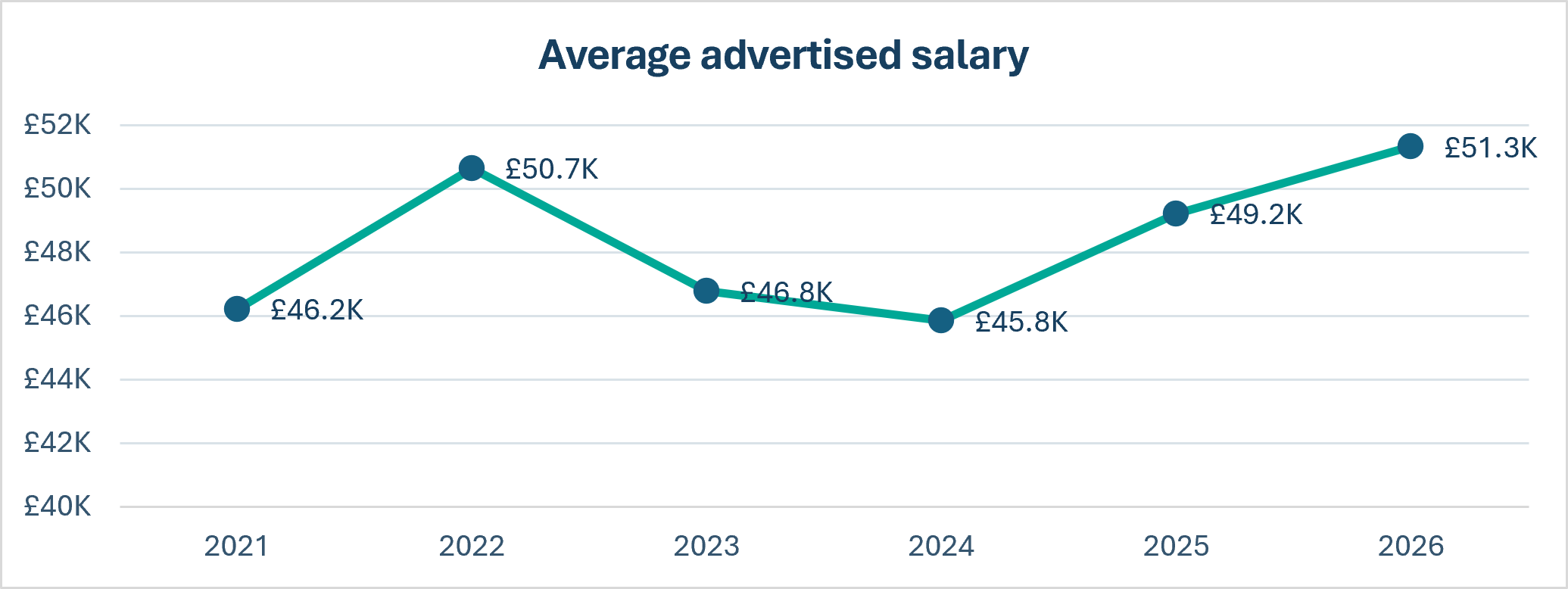
Sector salary is at a six-year high – the average advertised salary reached £51,320 in 2026. That represents an 11.1% improvement over the 2021 figure of £46,200, and an uneven trend along the way as a 2022 average of £50,700 fell under £46,000 in 2024, before recovering to 2026 levels.
Our take on the latest sector skills findings
The engineering and manufacturing sector is still a strategically important sector, with some softening of vacancy demand, and gradual change in its skill mix. Core technical capabilities remain central, while the growing focus on common skills suggests adaptation in how work is organised and delivered rather than evidence of fundamental disruption by AI.
Does the data we’ve dug up in honour of National Manufacturing Day ring true with your own experiences working within the engineering and manufacturing sector?
On our LinkedIn page you’ll find more insights from our work exploring the sector.
Follow us on LinkedInMore news